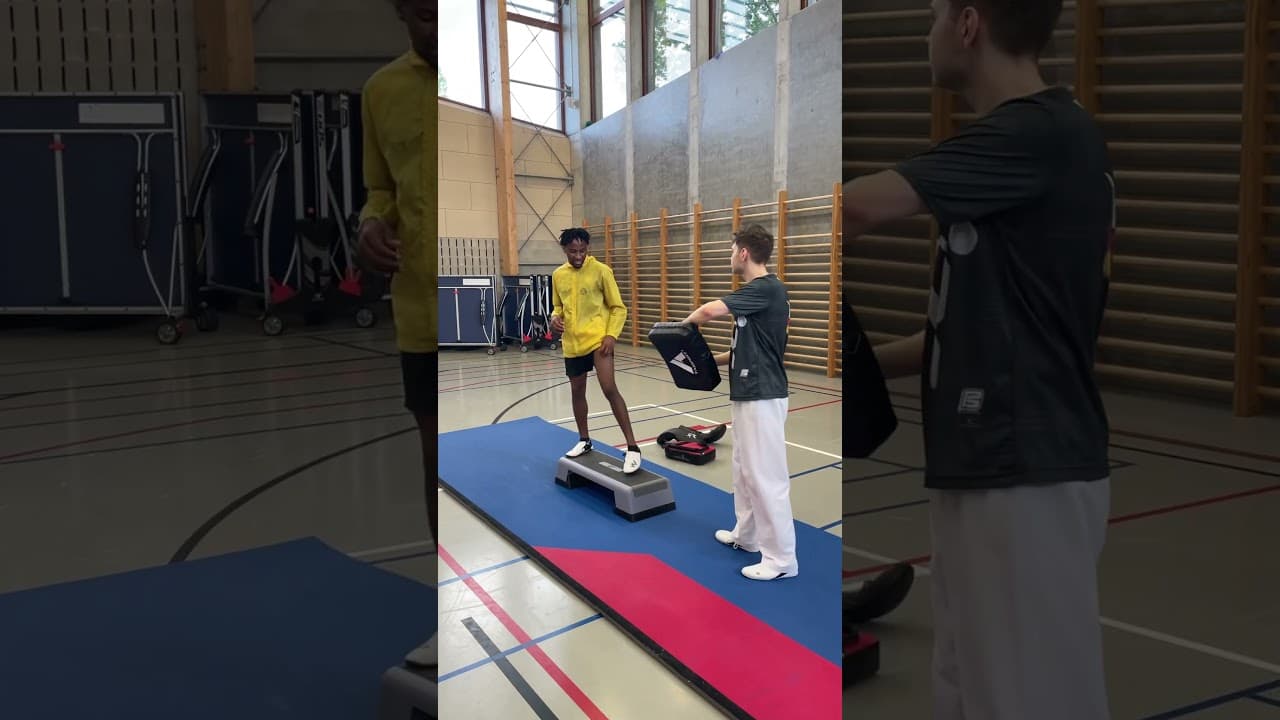
Half-Turn Jump Drop-Back Step Rear Leg Kick: Turning Reaction Into Power
You do not win rear-leg exchanges by being stronger on paper. You win them by getting your stance organized and your kick out in the first fraction of a second after you land. The Half-Turn Jump Drop-Back Step Rear Leg Kick over an elevated surface is built for that moment, when you twist, drop, re-load and fire before your opponent has even processed your movement.
The Strength & Conditioning Principle Behind This Drill
This exercise sits at the intersection of reactive plyometrics and sport-specific stance control. You are using a short half turn to pre-load the hips, then a fast drop landing with under 200 milliseconds contact time to convert the elastic energy of the jump into rear-leg kicking power. The elevated surface forces you to manage height and direction without losing balance, while the duo format adds decision speed and timing pressure.
From a strength and conditioning perspective, you are training the lower limb to produce force quickly in a taekwondo stance, not in a symmetrical gym position. Research on taekwondo athletes supports this approach. Progressive and velocity-based resistance methods have been shown to improve lower-limb movement ability in taekwondo, particularly when training is oriented around speed of force production and movement quality rather than just load, which aligns with the fast, controlled drop-and-fire pattern in this drill (Huang et al. 2025, PMID 39109891). Body composition and muscle power also influence repeated kicking speed, so exercises that challenge both power output and technical organization of the kick, like this one, directly target what drives scoring volume under match fatigue (Apollaro et al. 2024, PMID 39728862).
Setting Up The Half-Turn Jump Drop-Back Step Rear Leg Kick
Start by choosing a stable elevated surface that gives you 20–40 centimeters of height. A low box, sturdy step or padded platform works well. Position it in the center of your drill space, with enough room behind and in front for the drop-back step and rear-leg kick. Stand on the surface in your fighting stance, rear leg loaded, eyes forward. Your partner stands at a safe distance in front of you, inside your field of view, ready to give you a timing cue or act as the target for your kick.
Your goal is simple and unforgiving: half turn, jump, land and kick with minimal delay. There is no time to adjust or wiggle your stance. The surface height keeps your jump honest, the half turn challenges your rotational control, and the partner stops you from drifting into lazy, predictable rhythms.
Execution: From Half Turn To Rear-Leg Impact
Begin in a stable taekwondo stance on top of the elevated surface, rear leg slightly loaded, front leg relaxed but active. On your partner’s signal, initiate a half turn in the direction that sets your rear leg up to kick once you drop back. Think compact rotation, not a big spinning move. You pivot the hips and shoulders just enough to challenge your balance and reorient your stance.
As you finish the half turn, jump off the elevated surface and allow your stance to travel slightly backward, so you land in a drop-back step position. Contact time is the heart of the drill. Aim for a sharp, light landing that feels like you are bouncing off the floor, not sinking into it. Both feet should hit in your taekwondo stance, with the rear leg already lined up behind you, knee soft, hip ready to drive.
The instant your feet touch the ground, fire the rear-leg kick. Do not adjust. Do not shuffle. Train the habit of trusting the position you achieved in flight. The rear leg should snap out aggressively to your target, with full hip extension and clean chamber and recoil. Your partner can hold a shield or pad at mid level or head level, or they can be a visual reference if you are shadow kicking. The key is that the kick leaves the floor within that early window after landing.
Let your body return to stance after the kick, then step back onto the elevated surface to reset. You repeat the sequence: stance, cue, half turn, drop-back, rear-leg kick.
For working sets, aim for 3 to 4 sets of 5–8 reps per leg, depending on your training age and current phase. Rest 60–90 seconds between sets to maintain reactive quality without turning the drill into conditioning only. The intensity should feel like high-quality sprints: each rep explosive, each landing crisp.
Throughout the drill, focus on a few critical cues. Keep your chest controlled in the air so you do not over-rotate. Land with your weight balanced, not dumped on the front leg. Let the rear leg win the race out of the stance. Your partner can call “kick” the moment you land to reinforce zero hesitation.
Duo Format: Building Fight-Relevant Timing
The duo format of this drill is more than just holding a pad. Use your partner to add timing and tactical layers. They can vary the cue timing slightly, forcing you to stay mentally sharp. They can change pad height between reps to simulate an opponent’s guard adjustments. They can move a half step in or out as you drop, so you learn to control your landing distance before firing.
This turns the drill into a bridge between pure S&C and sparring. You are still in a controlled environment, but your brain has to solve stance, distance and timing problems at speed. That is exactly the environment in which reactive power becomes fight-ready power.
Why This Drill Matters For Taekwondo Performance
Use this exercise when you want your rear leg to feel fast and inevitable off reactive footwork, not just powerful in isolation. It attacks the weak link that often shows up in competition: the tiny delay between landing and kicking that gives your opponent time to counter.
Here are the key benefits for serious taekwondo athletes:
- Sharper reactive rear-leg power off drop-back footwork
- Improved stance stability and balance after rotational jumps
- Faster contact-to-kick timing under partner-based cues
- Better hip and core coordination for half-turn direction changes
- Greater transfer of plyometric training into real match kicking patterns
Research on striking sports shows why this matters. When athletes throw repeated kicks, the supporting leg and the striking leg work together, with fatigue shifting muscle activation patterns across both roles (Wu et al. 2025, PMID 41461813). In practical terms, your ability to keep landing positions clean and to organize the rear leg under fatigue depends on how you have trained that support-strike synergy. A drill that combines rotational control, drop-landings and rear-leg firing directly supports that requirement.
Coaching Cues To Make The Drill Work
Treat every rep as if your opponent is closing the distance on you. Before you jump, lock in your stance posture: chin neutral, shoulders relaxed, core set. During the half turn, think compact rotation. Your hips turn just enough to challenge control, but your eyes stay locked to the partner. If your head spins, your balance will follow.
As you leave the elevated surface, keep your knees slightly bent and your core engaged. You are not chasing hang time. You are chasing a clean, controllable landing angle. The higher you jump, the more likely you are to land heavy and lose contact speed. Instead, use moderate height, under fifty centimeters, and prioritize precise foot placement.
On landing, listen for a quiet contact sound. Heavy thuds usually mean lost stiffness in the ankle and knee, which slows your transition to the kick. Feel your weight distribute evenly through the stance. If you repeatedly land with your front leg overloaded, shorten your drop-back distance slightly until you can land balanced, then gradually increase distance again.
For the kick itself, let the rear leg be ruthless. The ball of the foot or instep should strike the pad with intent, and the hip should drive through without collapsing your upper body. Maintain guard; do not let the drill turn into a sloppy conditioning exercise where your hands drop. Your partner can call you out every time guard position breaks.
Over time, your goal is to make the connection between landing and kick automatic. No extra thought. Land, drive, reset.
Programming And Progression
Integrate the Half-Turn Jump Drop-Back Step Rear Leg Kick into your weekly plan like a power and coordination bridge between weight room work and sparring. It fits best after your main strength or plyometric block, when you are still fresh enough to move fast, but already activated.
For most competitive athletes, 2 weekly sessions with this drill are enough to see changes in contact-to-kick timing. Start with 3 sets of 5 reps per leg in week one, focusing on technical precision and balanced landings. Across the next 3–4 weeks, progress toward 4 sets of 6–8 reps per leg, maintaining quality. If your contact time starts to stretch and you feel yourself pausing before the kick, cut the reps per set and add a set instead. Quality beats volume.
You can progress this drill in several ways. First, manipulate the cue timing. Have your partner vary the moment they call the half turn or the kick so you cannot pre-empt the sequence. Second, adjust target height. Alternate mid-level and head-level kicks to force you to organize the hip differently off the same landing. Third, change distance slightly. After you master a consistent drop-back, let your partner drift a half step closer or farther, so you learn to feel range across different landing positions.
As your reactive power improves, you can pair this drill with related strength work. For example, a cycle focused on velocity-based resistance training for the lower body, such as fast squats or split squats executed with controlled load and high bar speed, will complement this drill nicely. That style of training has been linked to improved lower-limb movement quality in taekwondo athletes, especially when your focus is on fast execution rather than maximal load numbers (Huang et al. 2025, PMID 39109891). The weight room builds the engine, this drill teaches the engine to fire in the stance you use to score.
Finally, build a simple progression across the season. Pre-season, keep the volume higher and the patterns slightly more variable, using this drill as part of a broader reactive footwork and kicking block. In the competition phase, cut the volume, sharpen the cues and keep the drill tight. Use it for neural activation and timing, not fatigue. A short set of crisp reps on fight day can be enough to remind your body how to link landing and kick without delay.
When you step onto the mat, the goal is clear. You half turn, you drop back, you land and your rear leg is already on its way to the target. Train this drill with intent and attention, and that sequence will stop being a conscious decision and become a reflex you can trust in the split second that matters.